Showing posts with label Weave work. Show all posts

Tuesday, 22 November 2011

Around the studio...


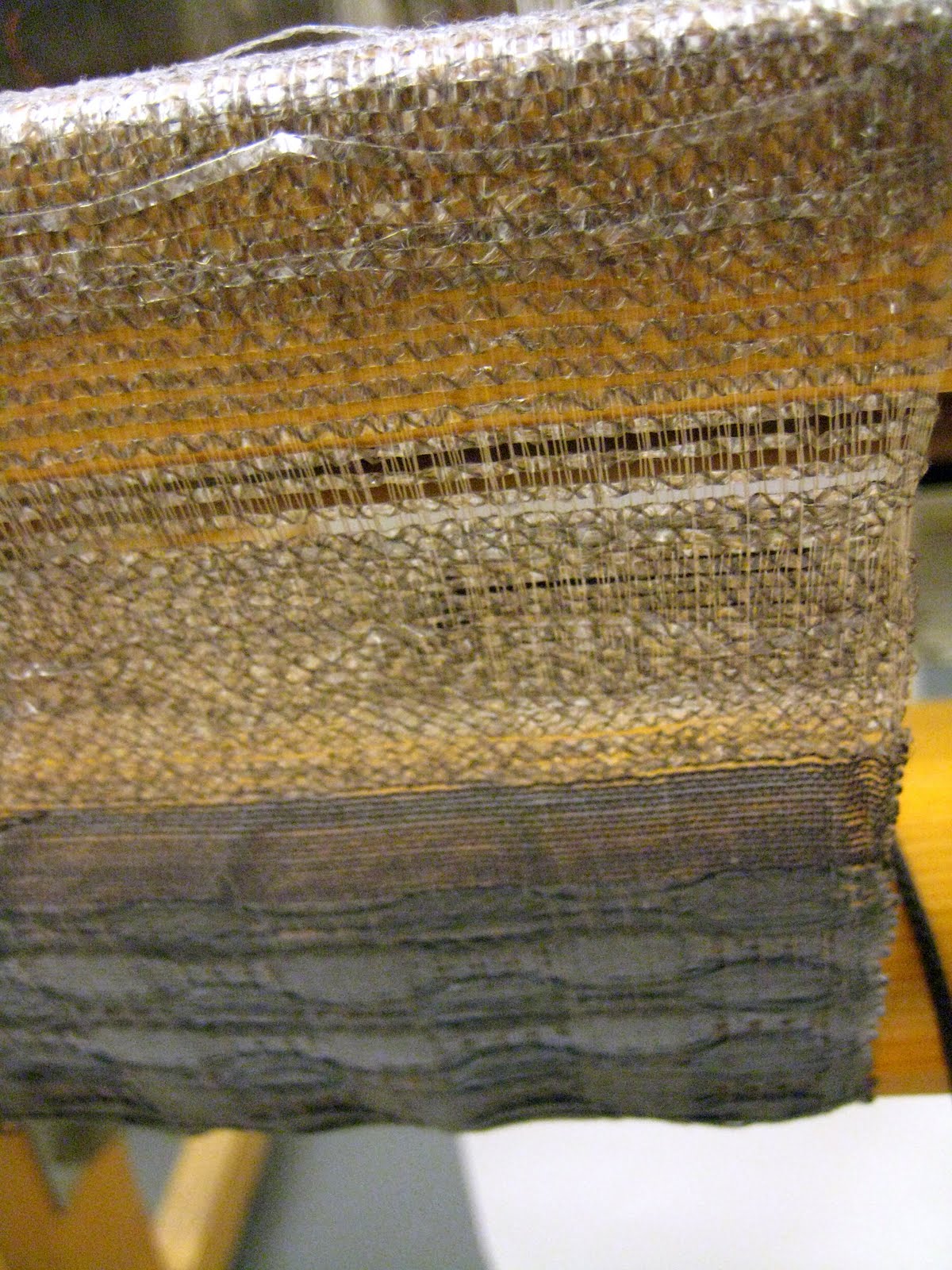
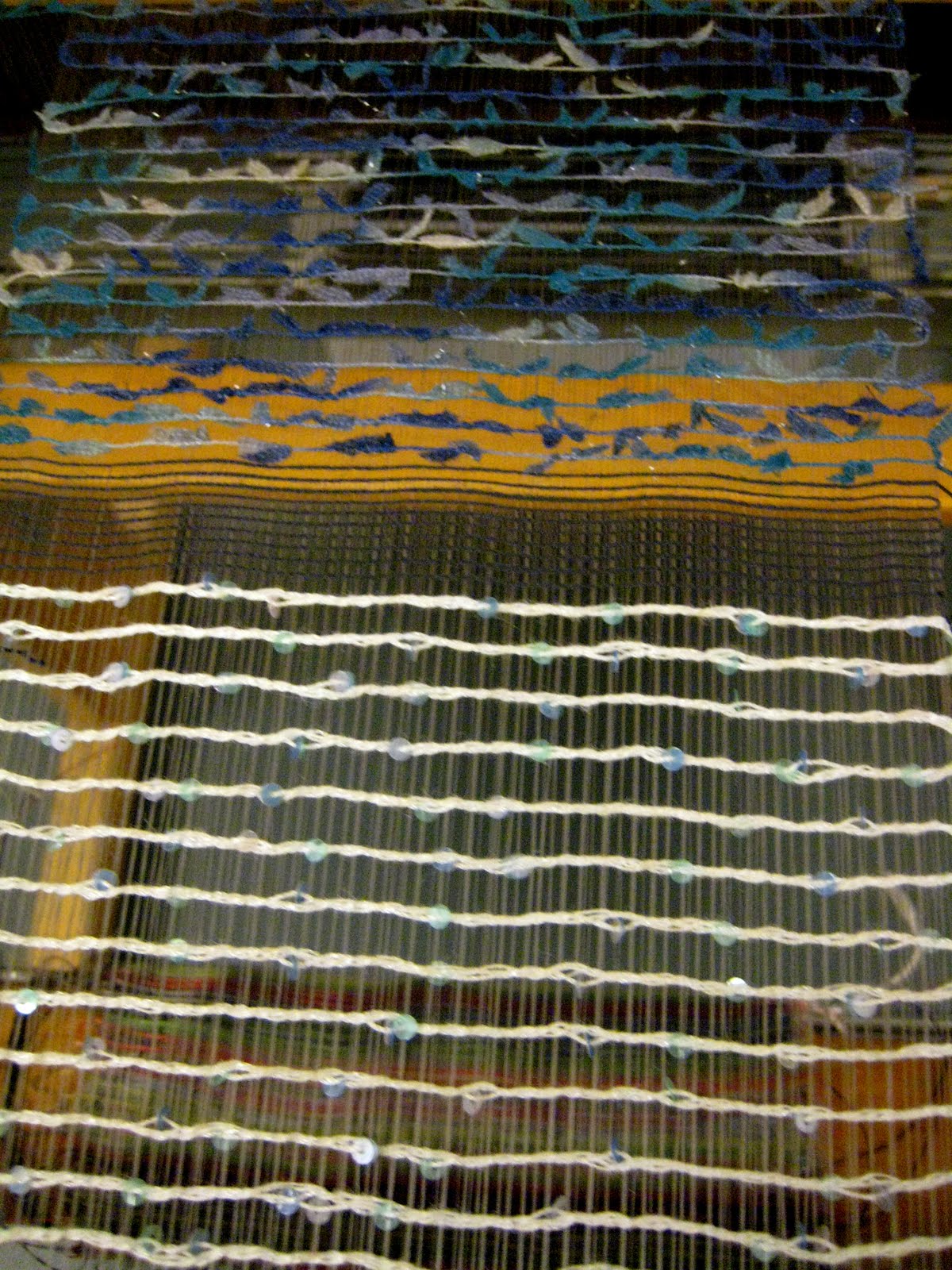
This is work by another 2nd year for their current "boutique hotel" project. From a distance it is hard to make out the weft material but it is in fact colourful electric wires. This struck me as an innovative way of reusing old wires of which I know there are abundance in recycling centers like my beloved Scrappies in Craven Arms. Definitely an interesting material to investigate further in the future.

Sunday, 20 November 2011

Loom number 7

DAMASSÉ SATIN DE 5

AMEUBLEMENT

CHAINE- COTTON


Like a few of the others, the fine quality of the warp threads meant that I suffered several broken strings during my work on this loom. For this montage, a simple weave structure was demanded (satin de 5) and we were to concentrate instead on colour and playing with warp and weft effects to hide/ reveal the white and black stripes. Although it was pretty much impossible to conceal them altogether so I suppose it was rather a matter of making them more or less dominant. As the different stripes were threaded on different shafts it gave us real freedom to be creative (well this is about as creative as I guess its going to get). And this little element of freedom made me feel extremely liberated! This joyous moment soon disappeared when I realized I hadn't been following the "satin rule" vigilantly enough and therefore my fils were not sufficiently "bloqués" (if the techer tried hard enough she could "bouge" (move) them by half a mm). I had another round of "Pourquoi pas?" and "Quel dommage", which ended with the inevitable, and much dreaded words "encore un fois"! Basically redo the whole thing!!!! Note to self- must learn Satin rule i.e. a pris must be followed by a laisse to block when changing patterns. This will not make sense to anybody but it is for my own future benefit should I wish to take up checked tablecloth manufacturing as a future career.


After beginning with cotton threads, I branched out into schappe soie as I am rather fond of a more silky, luxuries feeling cloth. I like how vividly the colours in the silk yarns appear. They are far glossier than the cotton which I suppose are more natural looking and practical for tablecloth material. All in all, I enjoyed working with this warp as although the stripes did add a bit of constraints to the final outcome, the freedom to design the cloth with blocks of colour and shape really gave me the opportunity to personalize my fabric.

Wednesday, 16 November 2011

Loom number 4

TOILE- MID D'ABEILLE/ FAUSSES PERLES

METIER À MANETTES (Another hand loom)

CHAINE- POLYAMIDE (Monofilament)

AMEUBLEMENT - PANOI/ ECRAN

After my complete and utter nightmare with Loom number 5 I really didn't think things could get much worse but Loom number 5 is quickly becoming my new nemesis! Initial confusion over the threading plan left me baffled as to why my weave structures were not working at all and my hours spent trying to create "Mid D'abeille" were very frustrating and totally unsuccessful. Clthilde had told me to try as it was possible and I have seen this dense honeycomb structure created on a monofilament warp before which I though looked really impressive and structural


It took me a while to realize why this weave pattern wasn't working at all. I had not noticed that the loom was in fact threaded on 16 shafts and not 24. I know this sounds like a fairly obvious thing not to notice but as it was the last 16 that had been threaded (i.e. shaft 9-24) I had simply looked at the back and seen 24 threaded and assumed it would be shaft 1 to 24. After this ridiculous error was acknowledged I got on with using more relevant (and hopefully successful) weave structures.


After experimenting with the Fausses Perles weave structure (above) I decided to simplify my weaves by using just toile (plain weave) and instead experimenting with unusual wefts. With this kind of freedom for the first time it was easy to get carries away! But the words of the teacher in the first week or so - "fantasy thread= use with caution" stuck in my mind. Unfortunately I was thinking of aesthetic effects and the practicality and durability of the cloth totally went out of the window. When my teacher (who has been away for nearly two weeks now) came back she said I had to "jeter", basically chuck most of my samples on this warp as they were too fragile and easy to dismantle as weaves. On reflection I should have used some clear monofilament to add plain weave in between each line of fantasy thread to give the cloth a more rigid structure. If I have time I will try and redo this.


I also wasted about 5 hours trying to create a rigid, textured cloth using a mid d'abeille (honeycomb) structure which Clothilde had told me was possible. No matter what I tried didn't seem to work and I couldn't figure out if it was a problem with the Gauffre weave structure I had designed or the slippy nature of my monofilament warp. I asked a third year who put me out of my misery- The warp simply did not have enough fils/cm (ends per inch) for such a structure to be realized as it has only 18 fils/cm. How frustrating.

The way of teaching here is so different and it is definitely hard to get used to. I think I have been told off by a teacher more in the last 3 months than in the last 10 years of my life. If a sample is unsuccessful they tend to shout at you for not having sat down and thought about it more beforehand. If you make a mistake within one of your samples you are told off and if you break a thread....well don't even go there. It seems technical perfection is the ideal. Whereas at Chelsea you learn from your own mistakes and experiment on the loom to find new and exciting possibilities, here it could not be more different. I wonder how well I will adapt back into the relaxed style of teaching back at Chelsea....

Tuesday, 15 November 2011

Work Update

Since Friday's meeting and evaluation I have continued weaving to my heart's content and have.....

-Completed two more samples on Loom number 5 (the one with the cotton and elastic/silk warp). Whoever initially threaded up the loom made countless mistakes crossing threads etc so I have to rethread the whole thing which slowed down progress significantly. After initially experimenting with toile on the elastic bands and more elaborate weave structures on the larger cotton bands I was told to stop. We were only supposed to use simple toile on this warp and chose appropriate colour threads as its aim was to experiment with a fabric textured by the warp. I suppose that a complex pattern would make the whole cloth far too fussy. It's just ever so tricky to get just the right amount of tension on both warps and especially to ensure the lycra warp is pulled taught enough or else no ripples will form!


-Returned to work on Loom number 1 (Linge de maison- nappe). I wanted to create a simpler linen cloth with my heart motifs so chose to redo this with a dark grey linen thread. I also wanted to experiment with creating a more textured cloth. Texture is something which really appeals to be as a textile designer.


By doubling up my cotton thread I have created a bobby surfaced cloth which I believe fits the purpose (tea towel fabric) as it would be ultra absorbent. Clothilde has argued that it would be too thick but I would like to wait until it is cut off the loom to truly be able to asses this.


I also decided to redo a Gauffre sample using smaller patterns so that the threads would float on the surface of the cloth less and therefore it would be more durable. I decided to tone down the colours and use a mixture of 2 grey linens as I am fully aware that some of my collections are far too jazzy as far as colours are concerned. However I do think I prefer the original melange of colours I used in my first Gauffre sample as it is rather more feminine!


-I have also done a couple of extra samples on Loom number 8 (with the nasty green, white, grey and blue stripes).
Firstly I wanted to do a plain sample using the weave I used on a previous cloth but omitting the dark stripes this time. It's a bit difficult to see this with it still on the loom as the dark shadows of the loose warp threads hanging beneath the cloth are still visible.


Also, during my evaluation and contemplation I realized that during my time working on this particular warp I became obsessed with the green and white check and therefore this came to dominate many of my samples. I have no idea why I adopted this as it really does not fit into any of my colour schemes. Therefore I decided to do another sample using burgundy and grey warp threads to mask the striped warp. I also designed a little triangle motif which I thought was rather reminiscent of the angular shapes of my minerals.


-And finally I returned to Loom number 10 to redo a silk, stripy sample in a more neutral colourway. In my opinion, sometimes samples look a bit dull and uninspiring on their own, but I know that once within a collection they are as important as the stand out, eye catching pieces to crete a good visual harmony and balance.

Sunday, 13 November 2011

To Do List

I am a lover of lists. And I find it increasingly easy to use pictures to make more of a visual list as my descriptions of samples can be very confusing and end up getting me in a right pickle. After Friday's Rendez-vous I have a lot to be getting on with and with only a week left in weave I had better work super hard this week.

1. Do a silky, stripy cloth for group 3 in order to have a finer, softer fabric in this group. (Possible colours- grey and light green).


2. Redo hearts without white stripe (or as my teacher calls it- a trou (hole)). Perhaps in group 4 colours or something simpler like a plain grey.


3. Redo my pocket (double cloth) sample in different colours. I have an abundance of light blue and pink pieces so use group 4 colours instead. Collection 4 also lacks a wooly sample.

White yarns- find a yellowey wool
Blue yarns- darker blue

If this doesn't work aesthetically then I should try and dye the sample.


4. Gauffres. Such a pretty sample with the flecked colour but threads can be pulled from the fabric too easily. I must redo the sample with a finer gauffre pattern perhaps in group 4 colours?


5. The colours of this sample are really grotesque. I think I was concentrating on diminishing the dominant stripes far too much and actually all notion of colour went out the window. I should either do this piece again, but instead of green and white, use a grey and burgundy to try and mask out the other colours. Otherwise I could attempt to dye this sample (in a casserole as Clothilde calls it) a grey or navy blue and see what happens.


6. The ground weave is really subtle and such a delicate colour and pattern. I believe it would work well as an all over pattern. To do this I must banish the awful grey and blue stripes of the warp to weave only with the more refined white an green stripes.


And the list goes on....

7. Cut tweed samples off loom.

8. Do a dark blue tweed (group 4).

9. Silky orange sample on cotton/ lycra warm using lycra in weft aswell.

etc etc. Or as they rather aptly say in France "et tout le bazar".

Evaluation

Friday proved to be an interesting day for me as I took the time to look through all the weave samples I have created so far and grouped them into 4 coherent collections.

It was surprising how many samples I had created as well as how easily I had drifted away from my original themes and colourways- something I do, unfortunately have a tendency to do! Comparing samples allowed me to evaluate their success and to make informed decisions to not use certain samples which didn't reach an acceptable level of quality or aesthetically were too weak. On reflection, it is probably something I should have done at a much earlier stage in order to better monitor and guide my direction. I think I have just been determined to get going on the different looms as quickly as possible due to our late start and the fact that our time is so precious.

I have divided my samples to date into 4 groups (some samples, e.g. the tweed had not been cut yet and therefore I couldn't group them.) Clothilde helped me think about what constituted a collection as it is all a bit foreign to me and not something we have really studied at Chelsea. Each group needed a collection of cloths with different textures and weights (some thick hardy wools and some delicate silks), a combination of both light and dark colours (as well as contrasts, dominants and neutrals), some highly patterned and some plain and some single coloured whilst other multi coloured pieces. Here are a few images of my groups to date.

COLLECTION ONE


COLLECTION TWO


COLLECTION THREE


COLLECTION FOUR


During working on the double cloth loom (loom number 10) I had considered myself to be building up a collection but on reflection my idea of a "collection" was really barking up the wrong tree. In each sample I had used the same colours and same threads. Instead, I should have experimented with different textured yarns and created some simpler one colour pieces to build up a more comprehensive collection. This collection (Collection Four) is seriously lacking diversity at the moment. I need to add some lighter more neutral shades to help crete an equilibrium such as an all light grey cloth. Also at present, the orangey, gold shade looks a bit sparse and random so I should concentrate on making it a dominant within some samples. This is the group I need to enlarge the most and I must concentrate on creating cloth with relevant colour ways.


The time I took to evaluate my work so far was incredibly helpful and insightful. I now realize what I must concentrate on producing during my final week of weave.

Tuesday, 8 November 2011

Loom number 5

PEKIN TOILE/ TOILE OU CANNELÉ/ SATIN

CHAINES- 1. COTON
2. SOIE/ LYCRA

VÊTEMENTS


I have just started weaving on this loom which is quickly becoming the bain of my life! In order to achieve the desired outcome- a textured scrunchy fabric, the two warps must be woven at different tensions. The lycra warp at an extremely tight tension and the cotton considerably looser. Achieving the perfect equilibrium is proving to be very difficult and if I had a pound for every broken thread I had fixed...well I wouldn't be desperately needing my erasmus grant! For one I think the cotton is very fine for such a complex warp- 2/120mm and in future I would probably try and avoid using such a fine, fragile cotton. Also our teacher has been ill for nearly a week now so with no one to advise on the perfect tension it's all a bit trail and error. I'm also struggling to find a suitable weft yarn which doesn't slip against the warp. I firstly tried with cotton yarns of the same diameter as the warp but found these too easy to pull apart on form holes in my cloth. As you can imagine, progress has been extremely slow but I will persevere!


Inspiration.

Walking through the workshops is always really inspirational. Whilst in first year, pupils are obliged to create straightforward pieces of cloth with simple weave structures and suitable yarns in the third year more freedom to experiment is allowed. And by the looks of their work this year, the results are truly incredible! It must be a release of all the pupils imaginative ideas that have been building up over the years. A girl called Claire has been working on a woven light structure. By using thick cord and wire covered in silk and weaving in occasional led lights she is creating long woven strips which will then be attached together to create a really unique and highly innovative alternative to the traditional bulb and shade!

Another weave which has caught my eye is this highly textured and vividly coloured cloth-


To help me to better understand its creation, I went back onto Loom Number 9 (the double cloth loom) to create a padded sample. Obviously my two warps were considerably different. For a start instead of cotton I had wool warps and also whereas both hers were out of the same yarn, mine were of different yarns and of different densities.


My initial sample was totally unsuccessful. My piqué pattern (pattern caused by the appearance of the underneath warp on the top face of the fabric) caused a few problems as far as the stuffing was concerned. A combination of too fine a pattern with too thick a stuffing yarn caused my stuffing to burst through the ground weave and become visible. After this I decided to keep things a little easier by simplifying by pattern so that the cloth resembled textured bands of different colour. This worked better although it didn't really have the X-factor I was hoping to achieve. My teacher said I could not achieve a more textured cloth which actually worked as a usable fabric on this warp. At least I have learnt the general method and can think about ways of increasing its visual impact in my weave work back at Chelsea.


Sunday, 6 November 2011

Loom number 3

SERGÉ "TWEED"

LAINE CARDÉE


As well as painting the warp, another thing I did not think I would be attempting again for a while was a hand operated loom. To be honest though, it was a welcome break from the temperamental computer linked looms which always seem to go a bit crazy. I really enjoyed the hands on nature of the loom and somehow felt more connected to the creation of the cloth. Strange I know as it takes about 10 times longer!

The aim of this warp was to create variants of tweed and I was advised to use Gardiner of Selkirk Scottish wool with a distinctly strong sheepy smell. I set the whole class off into giggles when the teacher asked me to sniff the yarn and tell everyone what it smelled like. I merely said "home". Turns out Wales' reputation has indeed stretched across the channel!

What's been really interesting during my time here is that gradually I am "learning to love simplicity" and becoming content with only using one weave pattern per sample, thinking about the lasting quality of my cloth etc.

My weaving patterns were mostly rather simple and straightforwards Sergés. I was advised not to beat very heavily as washing the samples would allow the wool to fuse and create a more whole cloth. Unfortunately, the rather vivid warp colours- red and yellow were rather dominant but all the same it was interesting to thing about other colours of a similar value to the ones already present to compliment.

In one sample I decided to experiment with "Effects Factices". I'm not really sure what the translation is but basically it's to do with using colours of a similar value in the warp and weft to achieve incredibly patterns. It all depends on the warp. Because this warp was threaded up with two red yarns followed by two yellow I was able to replicate this rhythm in the weft (two red followed by two yellow or other colours of an equal value) to create interesting motifs and pattern. I have photocopied many, many notes on this technique and it is definitely something I would like to look into further in the future.


Loom Number 10

DOUBLE FACE TRAME

TOILE BAYADÈRE

CHAINE POLYAMIDE


I remember doing a little experimentation with double cloth during my Garden project at Chelsea but I only really skimmed the surface. I therefore really enjoyed having the liberty to play around with different surfaces and contrasting sides and patterns.


I started off using wool and a linen but found this created a rather stiff cloth. The same was true for the sample below which has linen thread on both sides.


Wanting to create a more elegant, supple cloth I decided to use silk threads. I chose to use rich colours to add to the luxurious feel which I believe has been achieved. The Polymide transparent yarn which made the warp allowed me to really make my weaves my own and gave me full freedom to design without the restriction of stripes or existent colour within the warp. It also made me begin to think about designing cloth for a collection and the necessity of some simple and some more complex pattern and design.


I am very pleased with the above sample as I believe the two sides despite contrasting as regards to material (wool and silk) they equally bind together well to create a harmony as specks of darker colour within the silk stripes can be seen within the mixed nature of the wool. I think it would make for a suitable cloth for a jacket. I will have to await the verdict of my teacher though!